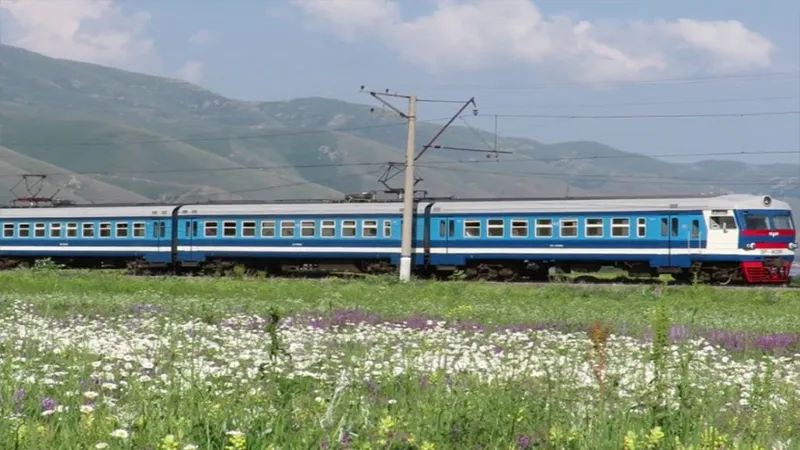
"Return on Investments" - under conditions: what does the concession agreement of the RA Railway Transport mean?
01-08-2026 10:50 Armenia Press of Diaspora
FIP The remote dispute between Yerevan and Moscow regarding the future of Armenia's railway system has entered a new phase, with the Russian side responding to the Armenian side with warnings about financial demands.
Thus, Oleg Belozerov, the CEO of Russian Railways (RZD), stated in an interview with Russian media on July 30 (1, 2, 3) that if the Armenian side decides to terminate the concession agreement of South Caucasus Railways LLC or change its terms, RZD has the right to expect the return of the investments made.
"All rights and obligations of the parties are defined in the concession agreement, which is also signed by the Government of Armenia. We, in turn, intend to strictly adhere to the contract, and if the Armenian side considers the possibility of its termination or change of terms, we have the right to expect the return of the investments made," he said.
At the same time, he presented the amount of investments made: "From 2008 to 2025, investments made from the funds of Russian Railways LLC and the own revenues of the South Caucasus Railways amounted to 146 billion drams, more precisely, 145.77 billion drams or about 396.3 million dollars. This entire amount is documented."
Maxim Reshetnikov, the Minister of Economic Development of Russia, also insisted in an interview on July 31 that the South Caucasus Railway is not an asset transferred free of charge to the Russian company; more than 30 billion rubles have been invested in it, and if Armenia unilaterally revises its obligations, causing damage to the investor, the Russian side will have grounds to demand compensation.
The statements of Russian officials followed Prime Minister Nikol Pashinyan's remarks that if issues with the South Caucasus Railways are not resolved, Armenia may resort to arbitration. He also suggested discussing the possibility of transferring the concession to a third party.
However, does the concession agreement signed in 2008 indeed provide for the unconditional return of all investments made by the Russian side? What compensation mechanisms are in place for various scenarios of contract termination, and can a change in terms itself create a financial obligation for Armenia?
"The Fact-Checking Platform" has examined the concession agreement and compared the statements of Russian officials with its provisions.
Recall that in February 2008, a concession agreement was signed between RZD and the Government of Armenia, under which the country's railway transport system was entrusted to the management of the Russian South Caucasus Railways. According to the document, the term of the concession management is 30 years, with the possibility of extending it for another 10 years by mutual agreement after the first 20 years of operation.
The agreement indeed provides for the possibility of claiming compensation, but its amount and legal basis depend on the reasons for the termination of the contract, possible violations by the parties, the profits received by the South Caucasus Railways, and the volume of investments confirmed by audit. Moreover, a change in the terms of the contract does not automatically create an obligation to return investments.
What does the agreement stipulate if Armenia terminates it?
The compensation mechanism in Article 17 of the concession agreement depends on:
Which party terminates the agreement,
On what grounds it is terminated,
Whether the South Caucasus Railways has duly fulfilled its obligations,
How much profit the company has already received,
What is the value of the rolling stock at the time of termination.
For example, if the Government of Armenia terminates the agreement on the grounds of any violation by the concessionaire, that is, the South Caucasus Railways, Armenia is obliged to pay only 50 percent of the difference between the investments made in infrastructure and the profit received up to the time of termination. This amount must be confirmed by an independent auditor.
In the case of rolling stock, compensation is not based on its initial purchase price but on its residual value at the time of termination, regardless of the appraiser's calculations. At the same time, the South Caucasus Railways is obliged to compensate Armenia for the amounts stipulated in the contract, including the actual costs of organizing a new tender, up to a maximum of 2 million dollars.
Therefore, even in this case, it is not about the return of all investments made.
If the agreement is terminated by the South Caucasus Railways on the grounds of Armenia's violation
If the South Caucasus Railways terminates the agreement based on a violation by the Government of Armenia, a different formula is applied. However, it should be noted that a proposal to amend the contract or to initiate negotiations by the Government of Armenia does not yet constitute grounds for the application of this clause.
First, a specific contractual violation must be recorded, the other party must be notified about it, and given the opportunity to rectify it. If the violation is not rectified within the specified period, the South Caucasus Railways may submit a notice of termination of the agreement.
In that case, the South Caucasus Railways may demand:
The costs and damages arising from the early termination of the agreement,
The total profit received in the three years preceding the termination of the agreement,
The difference between the investments made in infrastructure and the total profit received until the termination of the agreement.
If the agreement is terminated less than three years after the start of the concession activity, the profit for the previous three years is replaced by three times the average annual profit for the entire period of activity.
The rolling stock is also calculated separately in this case; Armenia must acquire it at the residual value determined by an independent appraiser.
Not all investments are returned
The agreement specifically mentions "investments made in infrastructure," therefore, the 145.77 billion drams presented by Belozerov cannot be fully included in this formula without clarifying its structure.
It is necessary to distinguish how much of that amount was directed to:
Railway infrastructure,
The acquisition or modernization of rolling stock,
Current maintenance and repairs,
Other expenses of the South Caucasus Railways.
For example, if the South Caucasus Railways invested 120 billion drams in infrastructure and received 30 billion drams in total profit before the termination of the agreement, it can claim 90 billion drams with the investment component, not the entire 120 billion.
Only in the case of not receiving profit can this component equal the total investment made in infrastructure. However, even in that case, the initial value of the rolling stock is not returned; it is acquired at the residual value at the time of termination.
The 145.77 billion drams published by Belozerov cannot be equated with Armenia's potential financial obligation. That figure includes the total investments made from RZD's funds and the own revenues of the South Caucasus Railways, while the agreement, as we presented above, treats infrastructure investments, rolling stock, and other expenses differently.
Regarding the termination of the agreement by mutual consent of the parties, in that case, no financial consequences are stipulated. According to the agreement, they are determined as a result of negotiations between the parties and the agreement reached.
Thus, Belozerov's statement is not entirely devoid of contractual basis. In the case of confirming a breach of contractual obligations by Armenia and the early termination of the agreement initiated by the South Caucasus Railways, the company can indeed demand the difference between the investments made in infrastructure and the profits received, as well as compensation for other expenses and damages.
However, Belozerov's formulation is incomplete and misleading. He equates the potential change in the terms of the agreement with its early termination, does not mention the legal conditions necessary for compensation, and creates the impression that Armenia is obliged to return the entire investment declared by the Russian side in all cases.
In reality, the legal basis and amount of compensation depend on the reason for the termination of the agreement, possible violations by the parties, the structure of infrastructure investments, the profits received by the South Caucasus Railways, the residual value of the rolling stock, and, in case of a dispute, the arbitration assessment.
* This text was automatically translated by Artificial Intelligence (AI).