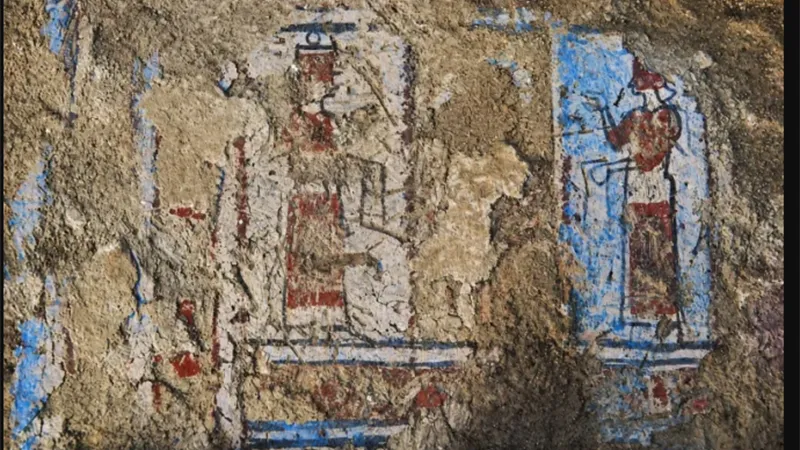
A fragment of a 2600-year-old mural has been discovered in Erebuni.
24-07-2026 13:56 Armenia Culture
The French-Armenian archaeological team has discovered a mural fragment at the Erebuni archaeological site.
According to preliminary estimates, the mural dates back to the second half of the 7th century BC or the beginning of the 6th century BC.
The Armenian-French excavations are led by the acting director of the "Erebuni" historical and archaeological reserve-museum, archaeologist Karen Azatyan, and the head of the regional archaeological service of the Île-de-France region of the French Ministry of Culture, Stéphane Deschamps. The expedition has been formed within the framework of cooperation between the "Erebuni" reserve-museum and the archaeological service of the French Ministry of Culture.
Erebuni fortress-city was founded by the Urartian king Argishti I around 782 BC. It, along with Argishti-Khinili (present-day Armavir) and Teishebai (Karmir Blur), was one of the three main fortresses of the Urartian state in the Ararat Plain. The construction of these fortresses aimed to strengthen Urartian power in the north, control the Ararat Plain, and concentrate the region's economic resources.
Studies of Erebuni in modern times began in 1879 when P. Ter-Avetisov, a resident of the village of Cholmakchi, discovered a basalt stone with a cuneiform inscription at the foot of the Arin fortress. In 1894, Alexey Ivanovsky, a member of the Imperial Archaeological Society of Moscow, acquired that stone and conducted exploratory studies at the Arin fortress, documenting visible structures. Two years later, in 1896, Mikhail Nikolsky, a researcher of Urartian cuneiform, published the text of the inscription, which mentioned the Erebuni fortress founded by Argishti Menouayordu.
Large-scale archaeological excavations at Erebuni began in the early 1950s. The work was led by architect and archaeologist Konstantin Hovhannisyan, with Boris Piotrovsky, an expert on Urartian studies, serving as the scientific advisor. Since 1952, the expedition of the Pushkin State Museum of Fine Arts in Moscow has also joined the excavations. During the Soviet years, excavations continued with the participation of various teams until 1975.
Embassy of France in the Republic of Armenia
* This text was automatically translated by Artificial Intelligence (AI).


 ENGLISH