The delegation of the Water Committee has familiarized itself with the leading practices in water resource and system management in Japan.
27-07-2026 17:00 Announcements
The Chairman of the Water Committee (WC) Aramazd Ghalamkaryan, along with the leading staff of the WC, representatives from the Ministry of Environment, the Yerevan City Hall, and partners from the Asian Development Bank (ADB), was on a familiarization visit to Japan from July 6-10, where the Armenian delegation participated in an experience exchange program titled "Armenia-Japan Partnership for Sustainable Lake Management and Sustainable Urban Development."
The visit was organized by the ADB, funded by the Government of Japan, and supported on-site by the Infrastructure Development Institute of Japan. During the visit, the Armenian delegation studied Japan's experience in the management of water resources and systems, the development of water infrastructure, wastewater treatment, and the sustainable preservation of lakes.
The Armenian delegation held meetings with representatives from Japan's sectoral government bodies, local self-government authorities, and specialized organizations.
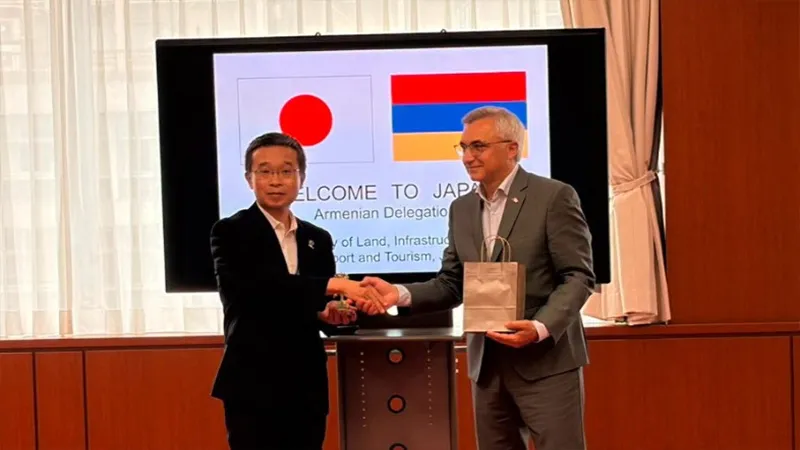
In the Ministry of Land, Infrastructure, Transport and Tourism of Japan (MLIT), the Armenian delegation met with Deputy Minister Kojiima Masaru. During the meeting, the state policy implemented in the field of water resource management and the programs for the development of water infrastructure were discussed, as well as the systems and approaches for managing rivers and watersheds were examined.
A meeting was held at the Ministry of the Environment of Japan with the Deputy Director of the Global Environmental Bureau, Ms. Masako Ogawa. During the discussions, the policies and programs implemented in Japan for the preservation of lakes and aquatic ecosystems, improvement of water quality, pollution prevention, and sustainable environmental management were presented.
During the visit, the Chairman of the Water Committee Aramazd Ghalamkaryan and the Armenian delegation presented the priorities of the reforms being implemented in Armenia's water sector, the programs for the development of water infrastructure, as well as the existing problems in Lake Sevan and Yerevan Lake and the planned works.
The next visit of the delegation was to Shiga Prefecture in Japan, where a meeting was held with Deputy Governor Azuma Masaru. During the meeting, the approaches used in the management of water basins, water quality preservation, and environmental protection were discussed.
In Shiga, the Armenian delegation became acquainted with the preservation and management practices of Japan's largest freshwater lake, Biwa, practical solutions aimed at maintaining the lake's ecosystem and water quality, as well as the capabilities for water sampling and laboratory research.
The inter-agency delegation from Armenia also visited:
The Biwa Lake Environmental Research Institute, where scientific research, environmental monitoring, and data-driven management approaches were presented.
The Biwa Lake River Office, where they were introduced to the comprehensive development program for Biwa Lake and discussed the integrated management mechanisms for water resources.
The Biwa Lake Museum, where the group learned about environmental education, public awareness, citizen science, and community engagement programs.
The International Lake Environment Committee (ILEC), where integrated management approaches for lake basins were discussed.
As part of the field visits, the delegation also became acquainted with the practical programs for the conservation of the Biwa Lake ecosystem, including the methodology for weekly sampling conducted at 51 points of the lake and the management of reedbed conservation areas, which play a crucial role in preserving habitats and breeding environments for fish and other aquatic organisms.
Particular attention was paid to decentralized wastewater treatment facilities used in rural and peripheral communities.
During the meetings, the possibilities for further cooperation in deepening Armenia-Japan professional collaboration, experience exchange, application of innovative technologies, and sustainable management of water resources were also discussed.
As part of the visit, the Chairman of the Water Committee also had an informal meeting with the Ambassador of Armenia to Japan, Monica Simonian, to familiarize himself with the embassy's activities and working conditions. The ambassador introduced Ghalamkaryan to representatives of the Armenian community in Japan.
The study of Japan's leading practices, effective management mechanisms, and innovative solutions is of great importance for the development of Armenia's water sector, the efficient use of water resources, and sustainable management.
Water Committee
* This text was automatically translated by Artificial Intelligence (AI).


 ENGLISH