The Deconstruction of Memory: Attempts to Erase Artsakh's Cultural Identity Institutionally in Armenia ("We Are Our Mountains" Monument as an "Anti-State Action")
The Deconstruction of Memory: Attempts to Erase Artsakh's Cultural Identity Institutionally in Armenia ("We Are Our Mountains" Monument as an "Anti-State Action")
16-07-2026 12:55 Armenia through the eyes of an eyewitness
The "Center for the Preservation of Artsakh Culture" NGO consistently records that the state bodies of the Republic of Armenia are not taking appropriate steps to protect the cultural heritage of Artsakh. Despite the available opportunities within the framework of international law, the relevant mechanisms are not fully utilized at the state level; processes are not initiated in UNESCO, relevant UN bodies, and other international platforms, and reports, communications, or legal initiatives are not presented with legal justifications to document violations against the Artsakh cultural heritage, to take preventive measures, and to implement mechanisms of international accountability.
It is a fact that the problem is not limited to state inaction. The public statements of the leadership of the Republic of Armenia are also concerning, as the issue of preserving Armenian churches and cultural heritage in Artsakh is presented as an internal affair of Azerbaijan. Such statements effectively weaken Armenia's legal and political positions and may negatively affect the effectiveness of future legal initiatives on international platforms.
Thus, a situation is being formed at the state level where the non-utilization of international mechanisms is coupled with rhetoric that internationally undermines the very legal foundations upon which future protective measures could be built.
Against the backdrop of this general indifference, information has received a wide public response, according to which certain cultural collectives operating in the Republic of Armenia have been given internal instructions to remove the word "Artsakh" from the titles of their works. To ascertain the credibility of this information, the NGO has sent an official inquiry to the Ministry of Education, Science, Culture, and Sports of the Republic of Armenia. In the ministry's response, it was stated that the ministry and its subordinate organizations have not received any written or verbal instructions regarding the removal of the name "Artsakh" from cultural works or historical and cultural materials. The same response also confirms that there is no prohibition on displaying symbols of Artsakh in institutions under the ministry's jurisdiction.
Although the ministry's response officially denies the existence of such an instruction, circulating information in the public sphere indicates that violations against the intangible cultural heritage of Artsakh are indeed occurring at the level of individual institutions and individuals, even if they do not stem from an official directive.
In this context, as a specific manifestation of the described general trend, the recent incident at the Anushavan Ter-Ghevondyan Music School in Yerevan can be viewed.
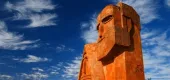
During the exhibition-competition, the acting director of the school removed a work painted by one of the students from the competition booth, which depicted the "We Are Our Mountains" ("Grandma-Grandpa") monument in Stepanakert, qualifying it as an "anti-state act." To obtain clarifications, the NGO has addressed an official letter to the Yerevan City Hall. In response, the city hall presented the written clarification from the director of the "A. Ter-Ghevondyan Music School" NGO without providing its own assessment of the incident.
The director's explanation that the picture was removed from the wall solely on the grounds of violating internal disciplinary rules (as it was posted without prior agreement with the administration) does not seem justified; the displayed work corresponded to the overall theme of the competition, and only the picture depicting the Artsakh monument was removed, raising questions about the real motives behind the decision. It is also significant that in the clarification presented by the director, instead of the official name of the monument ("We Are Our Mountains"), the phrase "the image of grandmothers and grandfathers" was used, which is hard to consider a mere linguistic slip, especially in the official text of an educational institution's leader. It is also noteworthy that shortly after the incident, the student's teacher, unable to come to terms with what happened, resigned.
The significance of this incident goes beyond a school incident. If the material component of the Artsakh cultural heritage—churches, monuments, and historical-cultural values—is endangered in the territories under Azerbaijan's control, then the intangible component—cultural memory, historical names, symbols, and identity—needs special attention in Armenia. Both processes, although manifested differently, affect the continuity of the same cultural heritage: one through physical destruction, the other through gradual removal from memory and public space.
It is important to understand that the accumulation of such individual cases, regardless of whether they stem from centralized directives or individual officials' initiatives, creates a systemic impact; the practice of normalizing silence about Artsakh or avoiding symbols associated with it is gradually being established in society.
The right to preserve cultural identity is an internationally recognized human right, stemming from the fundamental principles of international law and enshrined in the Universal Declaration of Human Rights, the International Covenant on Economic, Social and Cultural Rights, and other international documents on the protection of cultural heritage. This right can never become a subject of political bargaining.
It should also be noted that the strategy adopted by the Government of Armenia for the preservation, development, and promotion of culture for the years 2023–2027 has established the protection of the cultural rights of Armenians forcibly displaced from Nagorno-Karabakh, the preservation of intangible cultural heritage, its inventory, and transmission to future generations as state priorities. The strategy directly states that after the events of September 2023, the normal chain of transmission of the cultural identity of the Armenian population of Nagorno-Karabakh has been interrupted.
It is here that the main contradiction emerges: the state-level declared policy and everyday practical manifestations do not coincide. As the example of the music school shows, decisions made in individual institutions can directly contradict the goals set by the state for itself, without any accountability or even official assessment for this.
By correlating the aforementioned manifestations—the non-utilization of international mechanisms, the gradual marginalization of Artsakh symbols in the internal public sphere, specific cases recorded in individual institutions, and a number of other realities—it becomes evident that the problem is systemic and requires not just responses to individual incidents but a consistent state policy.
This calls for the attention of international and local human rights organizations, institutions engaged in the preservation of cultural heritage, responsible state bodies, as well as the media to the facts and recorded concerns presented in this statement.
Arev Margaryan
"Center for the Preservation of Artsakh Culture" NGO
https://www.facebook.com/share/p/1E8HRCUMBM/
--
Respectfully,
"Center for the Preservation of Artsakh Culture" NGO
Address: Republic of Armenia, Yerevan, Nairi Zaryan 17A
Warning: include_once(pages/inc_sidebar_livestream_youtube.php): Failed to open stream: No such file or directory in /home/u247475421/domains/poll.nt.am/public_html/pages/page_news_new.php on line 244
Warning: include_once(): Failed opening 'pages/inc_sidebar_livestream_youtube.php' for inclusion (include_path='.:/opt/alt/php83/usr/share/pear:/opt/alt/php83/usr/share/php:/usr/share/pear:/usr/share/php') in /home/u247475421/domains/poll.nt.am/public_html/pages/page_news_new.php on line 244


 ENGLISH