Baku and Ankara are in "disagreement" regarding the Armenian-Turkish normalization issue.
04-08-2026 15:48 Politics
1in.am Hikmet Hajiyev, assistant to Ilham Aliyev on foreign policy, reiterated in the "comments" for Turkish Haber Global television that there will be "no obstacle" to signing a peace treaty if the "key article" in the Armenian constitution that stipulates territorial claims against Azerbaijan, as well as Turkey, is "removed." In any case, this is how his statement has been presented by Baku's state media.
Hajiyev's "comments" followed the recall of Azerbaijan's ambassador in Turkey and the new appointments of the consuls general in Istanbul and Kars. The "controversies" in Turkish-Azerbaijani relations began with an interview of Azerbaijan's former ambassador Rashad Mamedov in Ankara, where he unequivocally asserted that Turkey "will not open the border with Armenia until Azerbaijan normalizes relations with Armenia." Several former Turkish diplomats sharply criticized Mamedov for expressing "uncoordinated views on fundamental issues on behalf of Turkey."
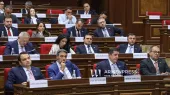
Regarding the "key article in the Armenian constitution that also stipulates territorial claims against Turkey" as an "obstacle" to signing a peace treaty, Hajiyev diplomatically requested Ankara not to "open the Armenian-Turkish border for now." It is certainly not a coincidence that he made these "comments" coinciding with the start of the first session of the Armenian National Assembly. Especially since recently it has been reported that Turkey "has begun construction work on the Kars-Gyumri railway and highway."
Hajiyev also addressed Azerbaijan's "support" to Turkey regarding the recognition of the Armenian Genocide by the Israeli government. According to Haqqin.az, he stated that Azerbaijan has "expressed serious concern" to Israel on this matter, as "Turkey's interests are a red line for Baku." The Russian-language Israeli site vesty had an interview with the already outgoing Knesset member Sova. He candidly admitted that the "cold response from Armenia was unexpected" for Netanyahu's government.
On such a sensitive issue, perhaps more is not said, and perhaps there is no need to delve into what calculations and motivations the Israeli government had when adopting the decision to recognize the Armenian Genocide. It is a fact that the Israeli foreign minister had a phone conversation with his Azerbaijani counterpart Bayramov the day before the cabinet meeting. After all, Turkey does not need Azerbaijan's support on this and many other issues. And if Erdogan opposes Israeli-Azerbaijani cooperation, then Aliyev will have no choice but to minimize relations with the Jewish state.
Of course, it is not worth speculating that there is a "wall of misunderstanding" between Baku and Ankara, but the pro-government minval politika wrote the day before the publicizing of Hajiyev's "comments" that "despite the influences exerted from various circles regarding the opening of the border with Armenia, the Turkish authorities continue to adhere to the agreements with Azerbaijan." What circles and to what extent "influences are being exerted" on Erdogan remains unknown for now. But the discussion is about "internal influences."
* This text was automatically translated by Artificial Intelligence (AI).