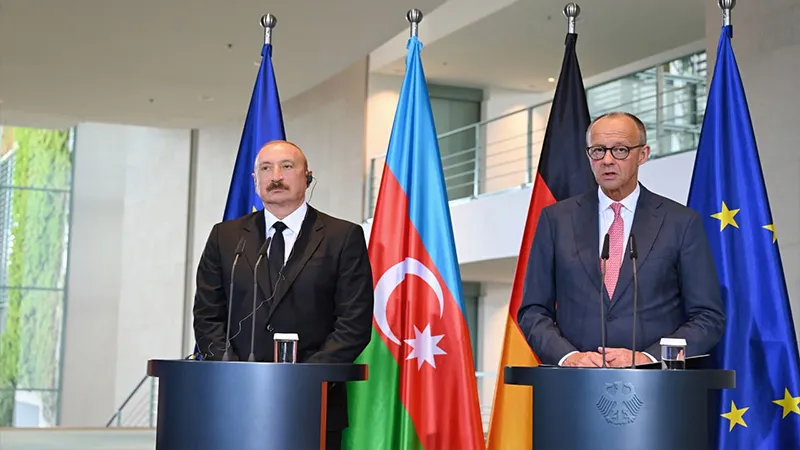
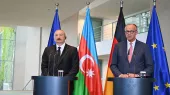
In Berlin, Aliyev did not receive the status of a "middle power" leader.
23-07-2026 13:50 Politics
1in.am The day after negotiations with the President of Azerbaijan in Berlin, German Chancellor Friedrich Merz had a phone conversation with Armenian Prime Minister Nikol Pashinyan. According to the official statement from the Armenian government, «the interlocutors exchanged views on current issues of the regional and international agenda, discussed the established peace between Armenia and Azerbaijan, and emphasized the importance of stable and lasting peace in the region». Prime Minister Pashinyan and Chancellor Merz also addressed the «consistent development of bilateral cooperation between Armenia and Germany, as well as the prospects for further deepening the Armenia-European Union partnership».
Azerbaijan's official propaganda has assessed Aliyev's visit to Berlin as «an indirect recognition by Germany of Azerbaijan's status as a middle power». Meanwhile, sources from the Azerbaijani diaspora in Europe have conveyed a diametrically opposite impression. They noted the fact that «leading German media outlets have hardly covered Aliyev's visit, and no television debates or analytical discussions on German-Azerbaijani relations have been organized».
The Azerbaijani side has not yet expressed an opinion on the Pashinyan-Merz phone conversation. Nevertheless, it is clear that Germany conditions its cooperation with Azerbaijan on the institutionalization of the actual peace between Armenia and Azerbaijan. Certainly, this process is viewed in a broader context of EU-South Caucasus-Central Asia connectivity.
It can be said with a high degree of confidence that Aliyev's visit to Berlin was organized to «bring him back». Azerbaijan has recently expressed dissatisfaction with the conference organized in Brussels on transport connectivity. State media have reported that the European Union is «doing a favor to one at the expense of another», clearly referring to the trends of involving Armenia in South Caucasus-Central Asia connectivity.
What practical results Chancellor Merz has achieved is still difficult to predict. However, the phone conversation between Chancellor Merz and Prime Minister Pashinyan the day after negotiations with Aliyev likely indicates that Aliyev has not received «mutual understanding» regarding the status of a «middle power», that is, a leading country in the South Caucasus.
* This text was automatically translated by Artificial Intelligence (AI).
Warning: include_once(pages/inc_sidebar_livestream_youtube.php): Failed to open stream: No such file or directory in /home/u247475421/domains/poll.nt.am/public_html/pages/page_news_new.php on line 244
Warning: include_once(): Failed opening 'pages/inc_sidebar_livestream_youtube.php' for inclusion (include_path='.:/opt/alt/php83/usr/share/pear:/opt/alt/php83/usr/share/php:/usr/share/pear:/usr/share/php') in /home/u247475421/domains/poll.nt.am/public_html/pages/page_news_new.php on line 244


 ENGLISH